Fiscal and Monetary policy: Importance of harmonising South Africa’s fiscal and monetary sides
The long debate of establishing harmony in between monetary and fiscal policies takes the limelight of this blog post as South Africa’s inability of meeting its preliminary goals in attaining economic prosperity has increased substantially. This is evident with the consistent revision and changes which have been made to economic policies by the democratic government since 1994. The range of economic policies adopted by South African government include:
- Reconstruction development programme (RDP) introduced in 1994;
- Growth, Employment and Redistribution (GEAR) introduce in 1996;
- Accelerated and Shared Growth initiative for South Africa (ASGISA) introduced in 2005;
- New Growth Path (NGP) introduced in 2010; and
- lastly the New Development Plan (NDP) introduced in 2013.
With the country’s recent economic policy, that is the National Development Plan (NDP) 2030, having a considerably larger time span of 17 years since its implementation as opposed to its predecessors much higher expectations have been held against the government action plans. However, with 2030 being merely 10 years away the effectiveness of the government has been questioned considering the current economic conditions the South African economy is currently facing.
NDP 2030 long term outlook is aimed at addressing socio economic issues, mainly inequality and poverty, which can be achieved in the event that the following conditions are met: inclusive growth within country, the state’s capacity is increased, and ensuring leadership within societies. The goals of the NDP 2030 can be summarised into four broad objectives: firstly, provision of overarching goals for achieving objectives in 2030; secondly, establishing an agreement on best methods for attaining objectives; thirdly, provision of a detailed plan for long term framework in maximising and advancing long-term goals set out in NDP.
These economic polices significantly contribute to the actions taken by the government as they provide a premise for fiscal policies along with accommodating monetary policy instruments. As predetermined these economic policies are primarily socio-economic driven initiatives aimed at addressing the high poverty and inequality levels in ensuring economic development is attained. This in turn is evident following the State of Nation Address (SONA) where President Cyril Ramaphosa highlighted priorities taken by his administration being:
- Economic transformation and job creating;
- Educations, Skills and health;
- Addressing spatial integration, human settlements, and local government;
- Addressing social wage issue through quality basic services;
- Ensuring social cohesion and safe communities; and
- Achieving an ethical development state.
Harmonising Fiscal and Monetary policies
In order to understand the importance of establishing harmonised polices, the interdependence of South African macroeconomic objectives along with role played by both fiscal and monetary side in achieving these is pointed out. The six macroeconomic objectives being: achieving economic growth; maintaining price stability; ensuring exchange rate stability; improve unemployment rate; reducing inequality; and improve balance of payments provide a supplementary framework for decisions taken on the fiscal side. Of these objectives the South African government has concentrated on three problems unemployment, poverty, and inequality where actions have been taken towards addressing these social problems. The latter is evident in the increasing expenditure patterns by the government over the past years where large budget allocations where made on social and development intentions.
This however is different in the case of the monetary side, where the South African Reserve bank (SARB) has been given the its main purpose (i.e. mandate) as determined in the constitution. SARB’s mandate as noted in the constitution states the following:
“The South African Reserve Bank (the SARB) is the central bank of the Republic of South Africa. The primary purpose of the Bank is to achieve and maintain price stability in the interest of balanced and sustainable economic growth in South Africa”.
As indicated above the SARB is concerned with only two of the six macroeconomic objectives that being maintaining price and exchange rate stability which it achieves by making a conducive environment possible in support of the government’s. This in turn explains the recent debate regarding a proposed change in SARB’s mandate by both National Executive Committee (NEC) member Ace Magashule and Public protector Busisiwe Mkhwebane, who found the mandate as less accommodating for country’s socio economic issues.
- Effect of fiscal and monetary policy on the South African economy
South Africa over the years has had its fair share of uncertainty as a result of economic and political instability within the country, which has in turn highlighted the significant role the government policies have in reducing these adverse effects. On the fiscal side, given the current trends in the economic growth and unemployment rates within the country evidence indicates that policy actions taken by state have not being effective. The South African economy initially hard its worst economic growth rate in over a decade for the first quarter estimated at a negative 3.1% which was then consolidated by an equivalent in the third quarter of 2019. The unemployment rate has not improved but instead increased to 29% the highest rate since the year 2008, where substantial portion of the unemployed includes majority of youth labour which has an unemployment rate of 56.4%.
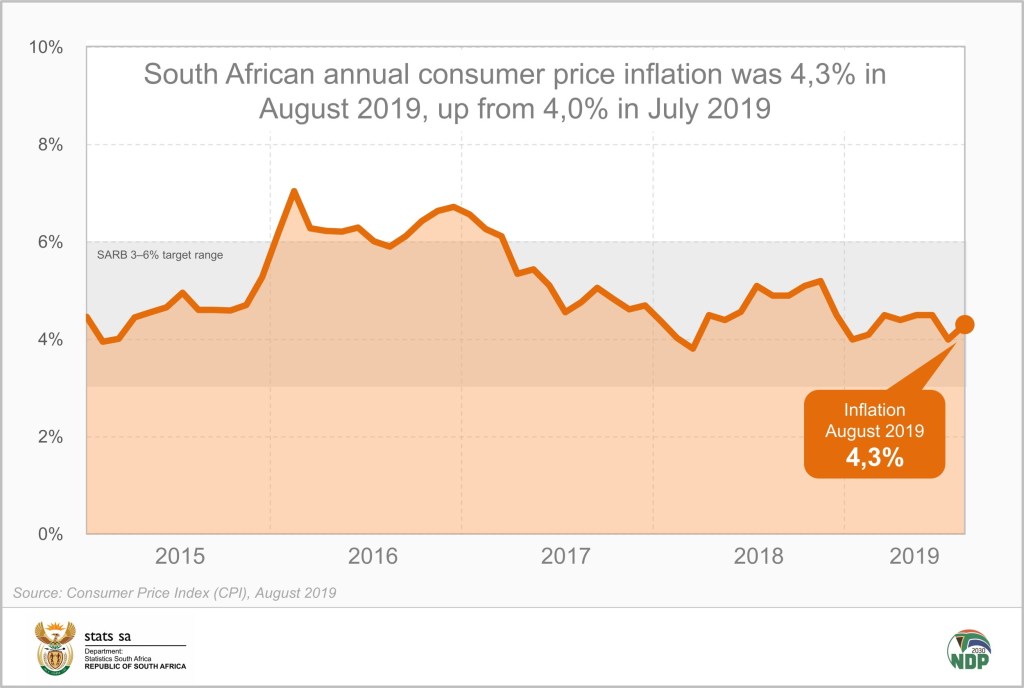
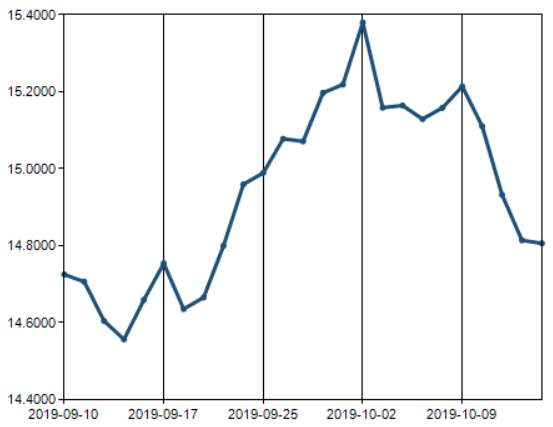
On the monetary side, the inflation rate has been within the inflation target range of 3-6% for respectable period with the last exceeding case occurring in the first quarter of 2017. This year the inflation rate has been trending in a stable manner being just slightly above 4% with the only unfavourable occurring in August 2019. Similarly, the exchange rate has been stable with minor cases of losses in Rand value following increased State owned entities (SOEs) debacles, with Eskom taking most of the limelight, which in turn affected the perception of their foreseeable future their operations.
The monetary implemented by the Eurozone, USA and Japan
The monetary policies of these parts of the world that is Eurozone, USA, and Japan are undertaken by the European Central bank (ECB), Federal Reserve Bank (FRB), and Bank of Japan (BoJ) respectively. These central banks share a similar purpose with that of the SARB hence serve as a benchmark in determining the best manner to carry out mandates through monetary policies actions effectively. The standard attribute these central banks (i.e. ECB, FRB, and BoJ) is a fixed inflation target of 2% which directs their actions in fulfilling their monetary objectives.
For the European Union the monetary policy actions taken within the ECB are made in the interests of 28 members. The ECB has a primary objective of ensuring price stability within the EU member states at a levels below 2% over the medium term. Based on the inflation rate trend in the inflation rate currently stands at rate below 1% (at 0.8%) late September 2019. The FRB has dual mandate aimed at ensuring price stable in the interest of attaining maximum employment. The United States’ has been within its intended target as late September 2019 it was estimated at 1.7%. The BoJ’s primary objective is ensuring the price stability in ensuring contributions towards sound development within Japan. The BoJ has been able to maintain an inflation rate below 1% from the beginning of 2019 with its latest September estimate being constant at 0.6%.
The significant role of central bank was realised in the first and second quarter of 2019 where global trade tensions and financial market imposed economic growth constraints on countries globally. In fulfilling their mandate the ECB, FRB along with the SARB decided to reduced their interest rates with the US based central bank, FRB, initiating this move early July where 25 basis points was reduced. This however, does not apply in the in the case of BoJ which chose to keep its rates constant going against decisions of other major central banks.
The fiscal policies implemented by the Eurozone, USA and Japan
In response to the slowing economic growth the ECB actions forced European governments to take on fiscal expansion in reducing the implications of reduced activity within the EU. The president of ECB, Mario Draghi, emphasised that countries with excess spending should act in an effective manner while allowing for automatic stability within respective economies avoiding possibility of countercyclical effects (i.e. inhibiting business cycles’ recovery). For the US government being at the front end of the global tensions as a result of its implementation of tariffs against Chinese produce still has a strong stands on prospect of benefits from increased protectionists. The Japanese government in response to the unfavourable economic condition has taken on a flexible fiscal policy in reducing effects of economic risks through increase planned spending in 2020 along with a sales tax increase (from 8% to 10%).
Recommendations for South African policymakers given the prevalence of a large degree of policy and regulatory uncertainty
Large amount of focus from the fiscal side has been on the social prospects of the country which has in turn limited the abilities of policies actions taken by the government. The policy makers should instead prioritise ensuring harmonious decision in between SARB and government in ensuring possibility of growth within economy following the unease global economic conditions.

