Protectionism and Anti-Globalisation
“ [Without trade restrictions] the obvious and simple system of natural liberty establishes itself of its own accord. Every man is left perfectly free to pursue his own interest in his own way…. The sovereign is completely discharged from a duty [for which] no human wisdom or knowledge could ever be sufficient; the duty of superintending the industry of private people, and of directing it towards the employments most suitable to the interest of the society “
— Adam Smith (In the Wealth of Nations)
Current conditions in the international trade market
In the recent world economic outlook for 2019 the International Monetary Fund (IMF) provided an overview of the current economic conditions in the world highlighting the significant conditions which have contributed to the deteriorating growth prospects of the global economy. The IMF concluded that world’s economic growth will experience a shortfall in the expected growth levels for 2019 and 2020 by 0.2% and 0.1% respectively compared to its forecasts in world economic outlook of 2018. In justifying this, the IMF identified “weakening global expansion” as the main contributing factor to losses in global growth emanating from conditions including trade tensions; political wars; and strict conditions in financial market. Of these three conditions only trade tensions and political wars take the limelight and as in the eyes of the IMF they are key risk indicators to the aggravation of downside implications to the world’s economic growth. The trade tensions between global economic giants, China and the United States of America (USA), have shook world growth as result of increased tariffs imposed between both countries.
As emphasised by Cerutti et al. (2019), the recent increased tariffs which have worsened tensions between China and the USA have the possibility of affecting the business and financial market, and distorting global supply chains in effect reducing ability of restoring global growth prospects. Despite the reduced trade between China and the USA, the bilateral trade deficit has been insignificantly affected as their trade concentration remains unchanged with China exporting-more and importing-less from the USA (Cerutti, 2019). Political war is one other condition or key risk indicator to the global growth prospects which has grown substantial in influence post- the appointment of Boris Johnson as prime minister of United Kingdom. With Boris Johnson being a highly pro-Brexit supporter this has created unfavourable tension between members of the European Union (EU) as the possibility of United Kingdom leaving the union has increased significantly. However, Chen (2018) identifies the costs of Brexit being unfavourable to the United Kingdom as their closest partners are EU members who make up 44% of its total exports worldwide. The significance of this share in total exports (that of EU members) is as a result of frictionless trading channels established via the EU agreements hence for the UK an exit from the EU can decrease this substantially with the possibility of high economic costs. According to Chen (2018) these costs include discouraged mobility of skilled labour (i.e. less migration); less foreign direct investment (FDI); and additional costs imposed on end-users of European produced products. With the current international trading environment being filled with turmoil emanating from trade-wars and political instability in the world’s biggest economies (such as China and United States), large amount of pressures has inadvertently affected small players from both emerging and developing sectors.
Is there still a place for free-trade?
In answering this question, it is important that all fundamentals of the concept of free-trade are understood which can bring to the light its purpose in international trade and global growth expansion. An ideal case of free trade is defined by Todaro and Smith (2015: 78) as being trade which occurs when goods are exported and imported without any barriers such as tariffs, quotas or other restrictions inhibiting the flow of the international trading environment. Todaro and Smith (2015: 78) describe free trade as a driving force for economic growth in advanced economies by identifying the extent of benefits gained from value-added activity through its export markets. Developed countries were able to maximise export earnings by using these in their industrialisation process through the establishment of large-scale manufacturing industries (Todaro & Smith, 2015: 78). Free trade in essence creates a long-term incentive from export earnings subject to the country’s ability of gaining capital accumulation via international capital market (i.e. attracting foreign investments); and it stable political structures and social institutions (Todaro & Smith, 2015:78). These in turn illustrates the importance of a free trade enabling environment which can be achieved if a set of political structures are put in place in achieving globalisation these include establishment of mutually beneficial trade policies and free trade agreements (FTAs).
According to Todaro and Smith (2015: 78) developed countries from both Europe and North America experienced much of dynamic growth in international trade as a result of free trade, free capital movements, and unrestricted migration of unskilled labour. However, the latter does not apply with respect to developing countries who have often experienced an unfortunate end of the benefits gained by their developed counterparts. Developing countries experienced a deteriorating trading position in world trade due to the differences in terms of trade (i.e. export-import prices ratio) even when their exports where growing as this growth was unfortunately reduced by these countries import costs (Todaro & Smith, 2015: 78). From this the one problem which stands out is the imbalance in benefits gained by both advanced and developing countries from the establishment of free trade environment.
The establishment of FTAs is based on the perceived benefits which respective members can gain from eliminated tariff or non-tariff barriers however Yi (2015) points out how these trade agreements tend to be underutilised as a result of technical aspects such as rules of origin. This point is reiterated by Stevens et al. (2015) who state that important details such as rules of origin can be unconsidered by trading partners despite their relevance in determining goods which receive tariff preference. The rules of origin as stipulated by World trade organisation (WTO) states “for the country to be determined as the origin of a particular good to be either: (1) the country where the good has been wholly obtained or, (2) when more than one country is concerned in the production of the good, the country where the last substantial transformation has been carried out”. The latter therefore illustrates why majority of developing countries were not able to benefit significantly from FTAs as these tariff preferences benefited industrialised economies which had large manufacturing capabilities. Hoekman (2013) reiterates this by identifying the minimum value gained by developing countries in the global supply chain is as a result of their little processing activities and abilities, with only employment and income being the only significant contributions gained by developing countries. Developed countries in turn have had the ability of maximising value gain from producing final products contributing significantly to both their competitiveness and productivity in the world. The value adding activity in supply chain plays an important role in developing countries as Hoekman (2013) points out that for developing economies being part of manufacturing process supports these low-skilled or labour intensive countries through firm’s establishment of assembling plants which often require mass labour.
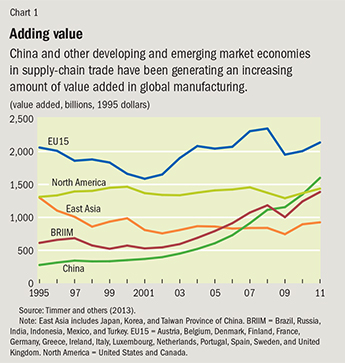
The level of global manufacturing contributions made by developed countries (including North America and European Union 15) have somewhat lagged in 2005 and 2008, which has allowed developing countries (such as China) to take advantage of this opportunity hence the consistent upswing in their manufacturing contributions as from 2005 (above figure). Despite this graph only accounting for years in between 1995 and 2011 only, the growing significant role of developing countries in global market is evident in export contributions made. In the world trade statistical review 2018 exports contributions made by the developing countries has grown by 3% from 2.7% in 2014 to 5.7% in 2017 as opposed to developed countries who only experienced a 1.4% (from 2.1% to 3.5%) in same period (WTO, 2018). Additionally, Asian countries contributed the highest to the 2017 world’s exports by 6.7% (increased by 2.2% from 2014) as opposed to North America countries which had 4.2% decreased by 0.2% from 2014 (WTO, 2018).
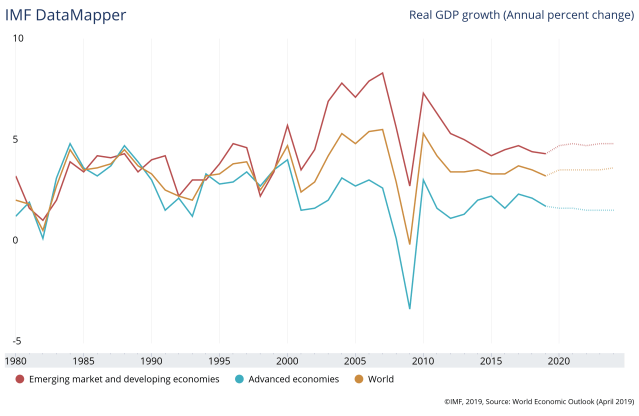
The figure above indicates the growing competitive ability of developing countries giving by their increasing GDP growth rate levels. The figure also shows how developing countries in the late 1990s were able to take over global growth against developed countries which only became definite in 2005. Since then developing countries have maintained a large positive growth rate differenced against their developed counterparts and the world as a whole. This highlights how the developing countries have grown in competitiveness with China amongst a few taking the limelight of this significant growth- and competition levels globally. Harris (2018) discusses that the growth in China’s competitive stance was due to its highly progressive cities amongst which are Beijing and Shanghai along new entrants being Changsha, Foshan, Nigbo, Tangshan, Wuxi, and Yantai. Both Beijing and Shanghai are included the in the world’s top 25 cities index competing with the like of highly acclaimed cities such as New York, London, Paris, and Tokyo who still have top spots (Harris, 2018).
The Chinese “Mega-cities” have been supported by strategic government efforts aimed at ensuring competitiveness through the creation of a business enabling environment in attracting investments from multinational companies, for which it has for companies such as Google (Harris, 2018). This brings us to the current perceived threat which China’s industrial policy imposes on not only the USA but global trade as a whole. The Chinese “Made in China 2025” ten year policy action plan seeks to maximise its high-technological sectors by developing advanced manufacturing sectors (McBride & Chatzky, 2019). With the Chinese seeking to dominate the tech sector its program aims to apply state subsidies, mobilisation of state-owned enterprises, and pursue intellectual property acquisition all with the intention of meeting the advanced tech industries in the western countries (including the USA) (McBride & Chatzky, 2019). Both McBride and Chatzky (2019) report on the concerns highlighted by the president of the USA, Donald J. Trump and his administration on the policy employed by the Chinese government being “discriminatory measures of foreign investments, intellectual property theft, and forced technology transfers” amongst other reasons they found to be uncompetitive. These reasons were considered by the president of USA as being adequate evidence of the probable threat the “Made in China 2025” policy was to the condition of United States’ tech sector. Therefore, tariffs were levied against Chinese goods along with legislation blockages restricting Chinese companies from acquiring of tech firms in the USA (McBride & Chatzky, 2019).
Unpacking the US-China trade war. Why are the growing protectionist & anti-globalisation actions?
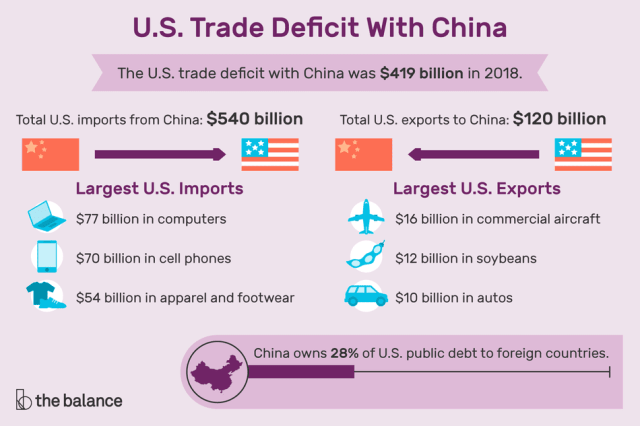
In understanding the incentive from USA’s position, i.e. its disinterest in Chinese products, in the ongoing trade war with China, the ideal purpose and reasons for protectionism are firstly described along with contributing factors to USA’s protectionist actions. Protectionism is defined by Abboushi (2010) as “the sum of government trade policies intended to assist domestic producers against foreign producers in a particular industry, by means of raising price of foreign products, lowering cost of domestic products, and limiting foreign producers’ access to domestic market”. This definition provides an overview of the purpose of protectionist policies being protecting domestic producers against growing foreign competition which the US government intends to do for its technological sectors through tariffs and regulatory restrictions imposed against Chinese companies. As predetermined the USA has a significant trade deficit against China, this is as a result of China’s large sum of exports with the top categories being: Aircrafts, computer hardware, cell phones, clothes, optical & medical equipment (USTR, 2019). The trade deficit is as indicated in graph below is about $419 billion and despite the US states increased tariffs impose on Chinese products this substantial has not decreased significantly as a result of China’s competing low prices.
China’s is recognised globally as a notorious producer of cheap products this as described by Nash-Hoff (2011) was as a result of the country’s national strategy towards becoming an important economic powerhouse in global trade of the 21st century. The Chinese government has for a long time applied concerning measures in interests of maintaining competitiveness of its own domestic producers, these include: VAT rebates intended for companies exporting Chinese products; unbalanced tariffs favouring domestic over foreign products; legal requirement for foreign companies based in china to have a Chinese partner with majority of interest in the company (i.e. can control company’s operations); and currency manipulation in favour of Chinese exporters against foreign competitors (incl. American competitors) (Nash-Hoff, 2011). Furthermore, the Chinese government established a legal requirement of transparency from the USA companies which entails sharing their technological developments and relocating their research & development facilities to China if they intend to access Chinese markets (Nash-Hoff, 2011). China’s low price strategy can be described as an act of “dumping” which occurs when one exporter sells a product into a another country a price less than its production costs (or home market price) (Nash-Hoff, 2011).
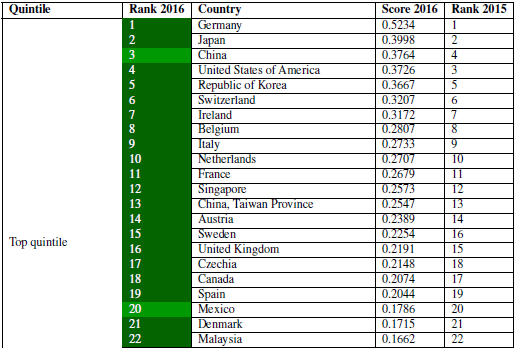
These are just among a few of the reasons why China has been considered by the Trump and his administration as being exploitative in its trade relations with the USA. The Chinese government have gained a considerable amount of influence over the past years which is evident in their competitiveness rank giving by the table below. China’s competitive and industrial performance is ranked third in the world followed by USA at fourth place (UNIDO, 2019). Much of China’s success and increased competitive was as a result of the safety-net provided by its government to Chinese companies through its policies. Despite these actions by the Chinese government, retaliation from US president is however still frowned upon as this does not improve the global free trading system but instead distorts its functioning capabilities. This is evident in the increasing production costs experienced by the domestic companies in both sets of countries which inevitably affects the contributions made to global growth and trade (IMF, 2019), as both countries have significant positions in the global economy.
What is South Africa’s position in relation to the USA and China, and how does US-China trade war affect it?
South Africa has and still shares interests with both the USA and Chinese government, however its closest trading partner is China as it not only accounts for 9.2% of its total exports with is equivalent to 8.7 billion US dollars (Workman, 2019) but also as a result of its alliance via BRICS. The USA still has contributes to South Africa’s export earnings by an acceptable amount of 6.4 billion dollars (6.8% of total exports) (Workman, 2019), however with president Cyril Ramaphosa siding with the Chinese government this highlights the perceived value the country stands to gain by being in close relations with China (Mkhwanazi, 2019). According to Mkhwanazi (2019) the USA’s blacklisting of Chinese companies such as Huawei, increased tariff pressures on Chinese products are perceived by the president Cyril Ramaphosa as an attempt on the USA end in reducing competitive edge Chinese companies have gained in the US. The effects of this trade war on South Africa is two-fold, entailing both an opportunities and costs:
Opportunities:
- South Africa has opportunity of exporting wine, fruits and nuts to China due to the tariffs imposed on US exports of these products;
- Additionally, with South Africa contributing 1.4% and 1.6% in steel & aluminum to US imports this creates for metals sector to increase its contributions however this comes at a cost of increased tariff implications (Fabricius, 2018);
- With recent reduction in Fed rate and predictions of possible further reductions in USA’s Fed rate (Smith, 2019), this creates an opportunity for South African importers to benefit from decreased costs as Rand can gain value against US dollar.
Costs:
- US tariffs on aluminum and steel create an uncertainty surrounding South African jobs as South Africa’s metal exports are substantially affected with the possibility of 7500 job losses (Fabricius, 2018);
- South Africa’s automobile sector depends on intermediate and input products which will increase cost of this industry (Fabricius, 2018);
- The South African economy depends on the intense nature of US-China trade war and with the negotiations resuming in September a possibility of an indirect recession is possible (Fabricius, 2018);
- The South African Stock market experienced a 4.92% decline as companies experience increasing wage cost along with uncertainty and stagnant growth (Matthews, 2019).
From the above it is clear that the trade war has more effects as opposed to benefits for the South African economy and therefore affects not only the country’s economic position in global trade but also its internal conditions (such as inflation; stagnant growth; unemployment costs).

