Climate change: A Parasite of economic development
The debate which has since gained prominence following multiple events which have forced community leaders, politicians, and environmentalists to engage in serious talks regarding the health of environment is climate change. This phenomenon rapidly caught the attention of people around the world following the recent events which captured the consequences of actions taken by both people and organisations such as the amazon fire and increased loss of ocean life. The perceived value of natural environment has been largely over-shadowed by self-interested behaviour which has led to higher effects on the future of global environment conditions. In establishing a clear insight into this environment it’s important that the concept of climate change is explained along with its implications on the society.
Climate change can be described as an unusual change in the normal weather found within a specific area or country. To the uniformed, this may be a seemingly expected change considering the recent rapid deviations in weather conditions across the world. However, it’s important to acknowledge that despite weather conditions being expected to normal change this usually happens over a long period of time often over 100 years. Unfortunately, rapid weather conditions have increased substantially in the past years as a result of rapid pollution and environmental affecting factors hence changes in weather have increased exponentially in only few years as opposed to this occurring in centuries.
Climate change is problematic across various aspects however only significant consequences are highlighted against the current living conditions. Firstly, global warming causes the Earth pole’s to meltdown resulting in increased sea-levels which currently make up 70% of the earth’s surface. Secondly, rapidly changing weather conditions impose possibility of drastic hazards on earthquake, tsunami, and mud-slide prone areas and countries. Thirdly, changing weather conditions result in forced wildlife migration which often seek cooler surroundings. Fourthly, specifies with populate the rain forest and other forestry areas also migrate towards coolers which imposes health hazards for people who reside in uninfested areas close to these species. Finally, the rapid changes in weather conditions affects the agricultural capabilities of a country which can lead to shortage of essential products for prolonged period of time.
Therefore, with the above consequences in mind countries have been forced to established policies which are in line with an ideal green economy. These policies are intended at redirecting the behaviour of both informed and uninformed economic participants (i.e. societies and organisations) within a country. The policies promote the efficient use and conservation of resources extracted from the natural environment which in effect provides base in attaining sustainable development.
The impact of climate change on sustainable development
Despite the move towards a more conservative approach in the production and use of natural resources, as climate change is already in motion this affects a country’s ability of achieving sustainable development. The concept sustainable development can be best described as economic development which is conducted without exploiting natural resources. In essence sustainable development can be composed into three elements: economy, environment, and people (i.e. triple-bottom line). The triple-bottom line provides a framework within which an economic participant is expected to operate in, hence in the case of sustainable development one of these three factors cannot be fulfilled separately without the consideration of the others. From this alone, it is clear achieving sustainable development can be complicated as pursuing economic development is subjective to meeting certain expectations which include reducing effects on natural resources and creating an opportunity for economic growth.
As predetermined, climate change imposes a couple of costs on current living standards which inhibits the ability of meeting the conditions of sustainable development. With climate change already affecting the public’s health, ability to produce food, access to clean water, and forcing migration actions this creates a problem for human development of a society. Therefore, the continued existence of this problem without any form of initiative towards its reduction can result in a loss in human development gains which have been gained in previous years. An example of the latter, is a possible a reduction in live-stock due or human capital due to sickness or hazardous weather conditions. However, investment in green policies aimed at reducing climate change can contribute to sustainable development as pollution and emissions would be addressed.
Impact of climate change on economic growth of developed countries Agriculture
Changes in rainfall, rising temperatures resulting in extreme events such as heatwaves, droughts, storms, and floods has led to dire impacts towards the process of harvesting crops and growth of livestock in which higher production costs have a negative impact on price, quantity and products, consequently, trade patterns which may negatively impact agricultural income in Europe (Franck, 2019). The agricultural sector is imperative not only to developed nations but to the entire world as the agricultural production highly depend on weather and climate conditions and as a result, this sector tends to be the most affected in any economy whereby significant economic losses are encountered (Cho, 2018). On the other hand, the United States of America is deemed as one of the biggest losers from climate change as Nebraska – which is amongst the largest areas in agricultural activity has lost $440 million worth of cattle, while Iowa had lost approximately $1.6 billion in losses. Hence, due to the imbalance of supply of crop and livestock prices are expected to continuously increase disrupting marketplaces locally and internationally (Belsie, 2015).
Human health and productivity
According to the National Bureau of Economic Research (2015) it state that the United States of America individual productivity workday decreases by 1.7 percent for each 1 degree rise in temperature that is above 15 degrees. While a weekday surpassing 30 degrees costs the nation an average of $20 per individual in lost income. If the United States doesn’t implement policies that slow climate change then, it is estimated that rising temperatures could decrease income growth by 0.06 to 0.16 percentage points on an annual basis. Cho (2019) emphasises the fact that if temperatures continuously increase, approximately 9300 people will lose their lives in the American cities on a yearly basis costing the government $140 billion. Meanwhile, increasing temperatures are estimated to lead to a loss of 2 billion in labour hours each year by 2090 resulting in $160 billion of lost wages
Green economy in developed countries
According to the European Environment Agency (2016) an economy to be pronounced green has to be made up of three elements. Ecosystem (natural capital) which is mandated to maintain ecological resilience. Economy (manufactured and financial capital) mandated to improve resource efficiency, and Human wellbeing (social and human capital) mandated to enhance social equity and fair burden-sharing (European Environment Agency, 2019).
Meanwhile, in the agricultural space two factors that make up the green economy namely – mitigation and adaptation can assist in reducing climate change. Both factors can have a significant contribution towards the development of communities that are more knowledgeable and resilient to the threat of climate change. This factors have led to the Common Agricultural Policy (CAP) which is mandated towards finding adequate solutions to challenges of climate change, more specifically, a sustainable EU agriculture. CAP has three objectives – firstly, cross-compliance mechanism which is the foundational layer of environmental requirements. Secondly, green direct payment which focuses on crop diversification ecological focus areas and permanent grassland. Thirdly, rural development. It’s without a doubt that rural development plays a pivotal role in the agricultural sector hence combating climate change. It has to be taken into account. CAP has developed two green policies towards rural development namely, restoring and enhancing ecosystems that depend on agriculture and forestry and, the promotion of resource efficiency in support of the shift towards low carbon and climate resilient economy (European Environment Agency, 2019).
Figure 1: Measures at farm level promoting green economy
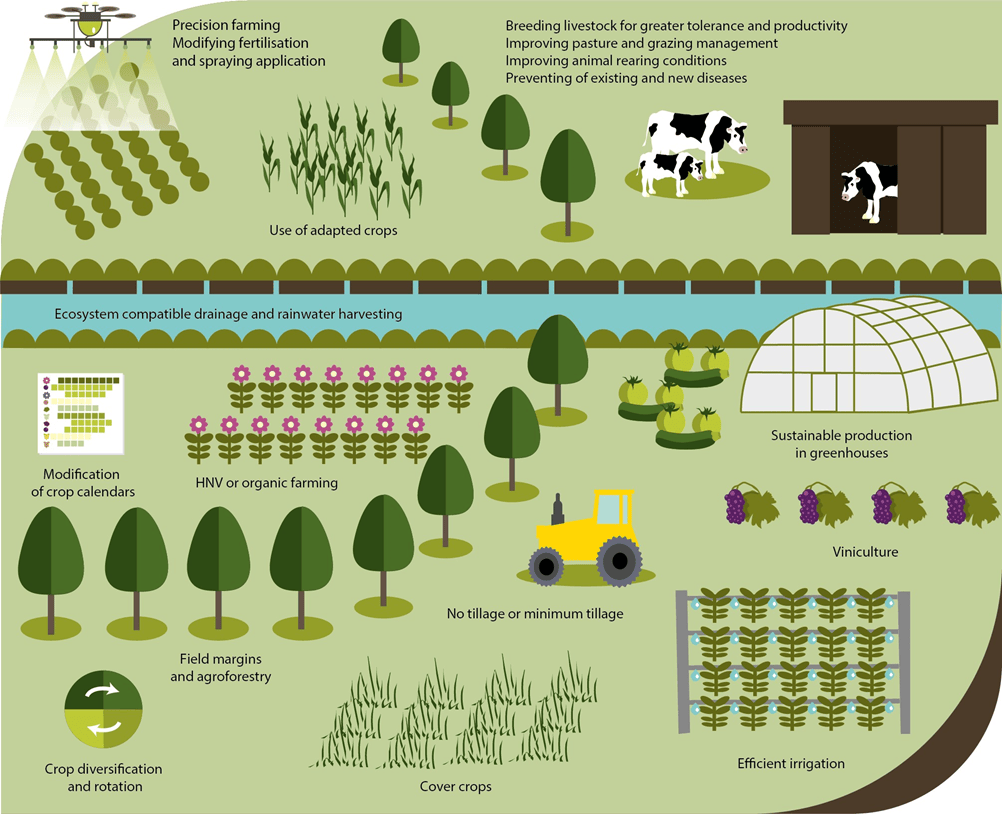
Figure 1 indicate that the agricultural sector plays an important role in reducing greenhouse gas emissions hence promoting green economy. Agriculture in the European Union accounts for 10% of all greenhouse gases. It is important to reshape the food system from fertilisers, manure storage and livestock. This can be achieved through the improvement of fertiliser usage, manure handling efficiencies. Meanwhile, consumer behaviour need to change too such as adapting to eating diets such as eating less meat while reducing food waste contributing to reductions of greenhouse gases.
Nevertheless, promoting a green economy brings about costs as the EU leaders discussed the climate change budget (Mc Mahon, 2019). EU leaders implemented the Multiannual Financial Framework (MFF) which deals with a financial volume of approximately 1.3 trillion euro which will be focused on making the green economy a reality. This sum will be spent in the next decade.
Impact of climate change on economic growth of developing countries Agriculture in Sub-Saharan Africa
It is a known fact that the agricultural land and productivity must increase in order to reduce poverty while maintain a sustainable level of food security as a result, the African economy is heavily dependent on agriculture. The agricultural sector employs 65% of Africa’s labour force making up 32% of the continent’s overall Gross Domestic Product (GDP). Agricultural GDP has risen from 2.3% each year particularly in Sub-Sahara Africa during the 1980s to 3.8% each year during the period of 2000-2005 (The conversation, 2015). This increase was due to land cultivation. However, an increase in temperature, and decline in rainfall has further hampered agricultural productivity increasing the demand for more land and water to make up for climate stresses. Climate change negatively affects developing countries food security since Africa has the most number of malnourished people, with fewer resources and fastest growing population. Egypt will probably loss 15% from its wheat production with 2 degrees temperature rise meanwhile, Morocco’s wheat is expected to decline significantly in 2030. (The conversation, 2015). In Sub-Sahara Africa, approximately 95% of crops is planted during the rain-fed agriculture. Hence, it suffers from lack of rainfall.
Agriculture in Southern Africa
Hopkins (2019) state that temperature increases in southern Africa are expected to be higher than the global average. Meanwhile, an anticipation of consecutive dry days is expected to rise as moisture in soil is also anticipated to decline. The South African agricultural economy had declined on a quarter-on-quarter basis in terms of a seasonally adjusted and annualised rate of 13.2%. The Western Cape experienced drought in 2016 which led to 30000 job cuts in the agricultural sector by 2018 (Smallhorne, 2018). Kings (2019) emphasises the fact that African countries would have had 24% larger economies if it weren’t for global warming. This is due to the world being 1 degree Celsius hotter than it was a century ago. Hence, Climate change costs South Africa 10% of its GDP, 29% in Nigeria, and 30% in India (Kings, 2019).
Green economy in developing countries
Renewable energy in China
China is prioritising renewable energy as it has taken significant steps in the achievement of low-carbon growth strategy which is based on the development of renewable energy sources. It has a five year plan aimed at per-unit GDP energy consumption decline by 20 percent by 2025. In addition, the government has committed to producing 16 percent of its primary energy from renewable sources by 2020 (Sukhdev et al, 2010).
Feed-in tariffs in Kenya
Kenya is predominately characterised by traditional biomass energy which aims to meet energy requirements of rural households while it heavily depends on imported petroleum for the modern economic sector needs. Subsequently, the country encounters problems that are related to unsustainable use of traditional forms of biomass and exposed to unstable high oil import prices (Sukhdev et al, 2010). Nevertheless, the Kenyan Ministry of Energy adopted a Feed-in tariff based on renewable energy sources (RES) which include solar, wind, small-hydro, and biogas.
Rural Ecological Infrastructure in India
India introduced the National Rural Employment Guarantee Act 2005 which guarantees wage employment programme enhancing the livelihood security of poor households in rural areas. It promotes inclusive growth, restores and maintains ecological infrastructure (Sukhdev et al, 2010).
Forest management in Nepal
Forestry plays a significant part in the economy of Nepal as it accounts for approximately 40 percent of land in the country hence, community forestry was implemented due to climate change destroying the forests (Sukhdev et al, 2010). This was evident during the 1990s as the area declined by 1.9 percent and during 2000 to 2005 the area increased by 1.35 percent fostering a green economy.
Quick facts about green economy in both developing and developed countries on the following areas (Sukhdev et al, 2010):
- Agriculture – it contributes the most towards GDP in developing countries employing approximately 1.3 billion workers globally.
- Buildings – New green buildings assist developing countries in meeting demand for both residential and commercial buildings while reducing energy consumption.
- Tourism – Investments in sustainable development of the tourism sector while encompassing green economy at the national and global level.
- Transport – Investment in green transport could assist cities in reducing congestion, and air pollution.
- Waste – a green economy is an economy that encourages the reduction, reuse, and recycling of waste.
RECOMMENDATIONS
Economic solutions to sustainable development in the landscape of climate change
In dealing with the environmental problems countries need to prioritise investing in sustainable development which as predetermined can indirectly reduce the implications and influence of climate change. The best way to achieve this, is by creating an environment which allows economic participants to contribute towards sustainable development despite the existence of prevailing climate changing conditions. Therefore, with the consideration of three elements (incl. economy, environment, and society) of sustainable development the government needs to ensure the following:
- Economy– an economic environment where renewable energy and efficient use of natural resources needs to be embraced, which can be done by promoting alternative production methods and investing green-infrastructure (e.g. solar power stations);
- Environment– enforcing a conservative mind-set in economic participants is important in reducing exploitation of natural resources hence environmental laws, green taxes, and resource rationing need to adopted. However, this is subjective to the enabling environment created for economic participants to function effectively despite new developments which illustrates the significance of embracing renewable energy;
- Society– in addressing the issue of climate change for a society it is important that the knowledge gap between the informed and uniformed is reduced in order to ensure people are aware of costs of pollution or non-environmentally friendly actions.
From the above recommendations a holistic approach towards attaining sustainable development is easily realised as across all different aspects similar interests towards environment preservations is standardised. Therefore, with every economic participant (incl. individuals and organisations) contributing towards economy while preserving natural resources sustainable development can be achieved and maintained effectively.

